Grow Your Revenue
Without Adding New Staff
OR Utilizing Your Time

Will AI Replace People in Small Business?
AI does not need to replace people in small business. Discover how it can handle repetitive tasks, support employees and help teams become more productive

One of the most common concerns about artificial intelligence is simple: Will AI replace people?
For most small and service-based businesses, the practical answer is not necessarily.
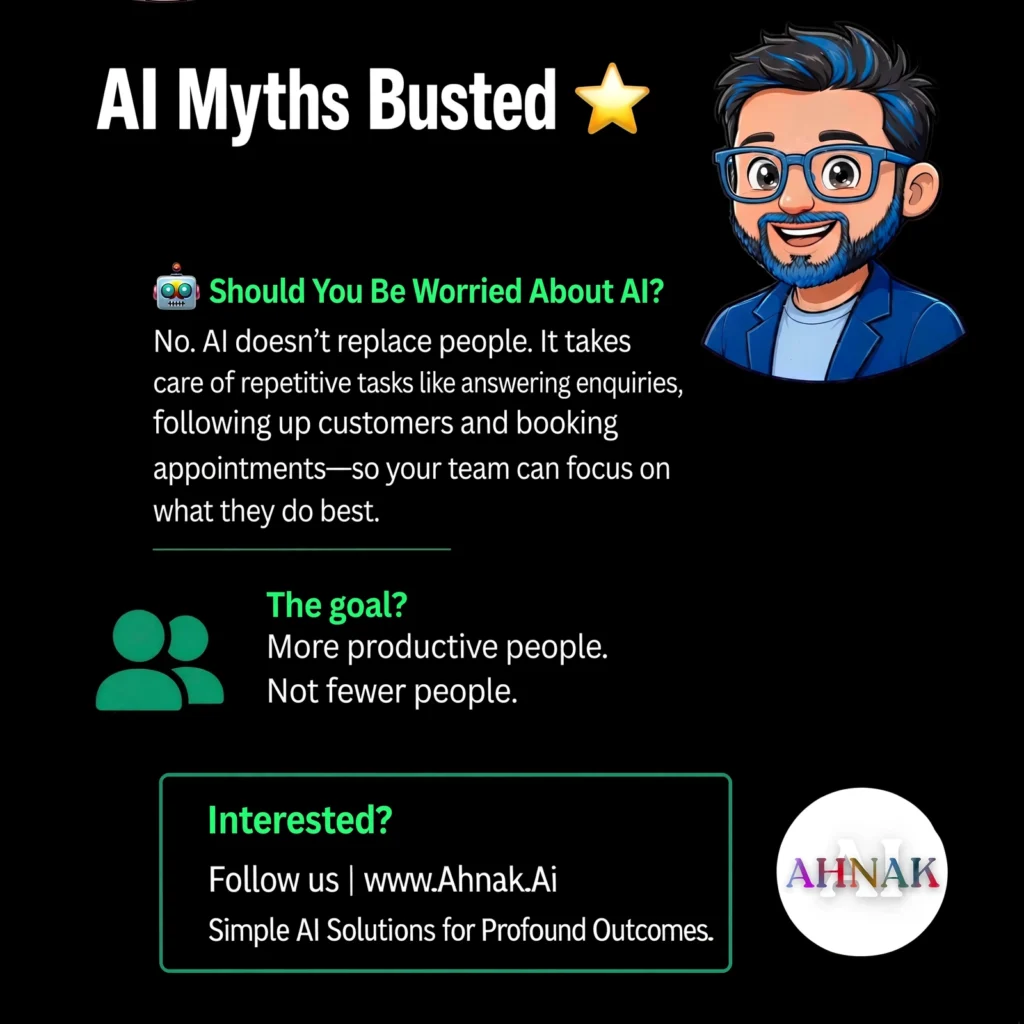
AI is generally most valuable when it supports employees by handling repetitive, time-consuming and predictable tasks. It can help a business respond faster, stay organised and manage routine customer communication, while people continue to provide expertise, judgement and personal service.
The real opportunity is not to create a business with fewer people. It is to help the people already working in the business become more productive.
Why Are People Concerned About AI and Jobs?
Rapid advances in artificial intelligence have created understandable concerns about the future of work.
Business owners and employees may worry that software will eventually take over complete roles. In reality, most jobs contain a mixture of different responsibilities.
Some tasks are repetitive and administrative. Others require experience, creativity, emotional understanding, physical work, decision-making or trusted relationships.
AI can often assist with the repetitive parts of a role, but it is much less suited to replacing the full contribution made by an experienced person.
For example, an electrician may use AI to acknowledge enquiries and organise appointments, but the system cannot replace the electrician’s technical expertise, safety knowledge and work at the customer’s property.
A tutor may use AI to send reminders or answer routine administrative questions, but the tutor still provides personal guidance, encouragement and an understanding of the student.
What Tasks Can AI Support?
When considering AI in small business, it is useful to separate tasks from complete jobs.
AI may be able to help with activities such as:
- Answering common enquiries
- Acknowledging missed calls
- Following up potential customers
- Collecting basic information
- Sending appointment confirmations
- Providing routine reminders
- Organising customer conversations
- Updating customer records
- Directing enquiries to the right person
These activities can consume a significant amount of time, particularly when the business owner is also responsible for sales, administration and service delivery.
Using small business automation for these tasks can reduce delays without removing the need for employees.
What Should People Continue to Handle?
People remain essential wherever the customer requires trust, judgement, expertise or personal attention.
This can include:
- Understanding complex customer needs
- Providing professional recommendations
- Making important business decisions
- Resolving sensitive concerns
- Managing unusual situations
- Building long-term customer relationships
- Delivering skilled services
- Applying empathy and common sense
AI may support these interactions by providing information or recording details, but the person remains responsible for the outcome.
AI Should Support Employees, Not Work Against Them
A useful approach to AI for employees is to treat the technology as an assistant.
For example, imagine a small service business receives several enquiries while the owner is completing work for an existing customer.
Without support, those enquiries may remain unanswered for hours. The owner later needs to review missed calls, reply to messages and remember which customers require follow-up.
An AI-powered system could immediately acknowledge each enquiry, collect basic details and organise the conversations for review.
The owner still manages the important parts of the customer relationship, but less time is spent on repetitive administration.
This is an example of human and AI collaboration rather than replacement.
Can AI Improve Job Quality?
When implemented carefully, AI can improve the quality of work by reducing some of the tasks people find repetitive or distracting.
Employees may spend less time copying information between systems, answering the same routine questions or manually sending reminders.
That time can instead be used for activities such as:
- Helping customers with more complex needs
- Improving service quality
- Building relationships
- Solving business problems
- Completing skilled work
- Developing new services
- Supporting business growth
The result may be more productive people, not fewer people.
When Can AI Become a Problem?
AI can create problems when it is introduced without clear objectives, human oversight or appropriate limits.
A business should not assume that every customer interaction should be automated. Some enquiries require a person from the beginning, while others can initially be handled through AI.
Businesses should also review the information provided by AI, protect customer data and ensure that customers can reach a person when required.
The technology should support the customer experience rather than create unnecessary barriers.
How Should a Small Business Introduce AI?
A small business should begin by identifying repetitive tasks that create delays or consume unnecessary time.
Useful questions include:
- Which questions do customers repeatedly ask?
- Which administrative tasks are regularly delayed?
- Where are enquiries being missed?
- Which follow-ups depend entirely on someone remembering?
- Which processes take time but require limited judgement?
The business can then introduce AI in one controlled area and assess whether it improves the process.
So what do you think? Will AI Replace People in Small Business?
Join our conversation and share your thoughts with us on
The Goal Is More Productive People
The question “Will AI replace people?” often focuses on the technology itself.
A more useful question is:
How can AI help our people do their best work?
For most small businesses, AI should handle routine support tasks while employees remain focused on expertise, service and customer relationships.
Used responsibly, AI can help create faster responses, more consistent processes and a better-organised business—without removing the human qualities that customers value most.