Grow Your Revenue
Without Adding New Staff
OR Utilizing Your Time

How Missed Enquiries Cost Small Businesses Money?
Missed enquiries can quietly reduce revenue. Learn why customers move on, how to identify gaps in your enquiry process and how missed call recovery can protect more opportunities.

How Missed Enquiries Cost Small Businesses Money?
Every enquiry represents a potential customer.
Someone may be calling for a quote, asking whether you provide a particular service, checking availability or trying to arrange an appointment. At that moment, they have already taken an important step towards choosing a business.
When that enquiry is missed or forgotten, the business may lose more than a phone call or message. It may lose the entire opportunity.
For small and service-based businesses, missed enquiries can quietly reduce revenue without appearing as an obvious expense.
What Counts as a Missed Enquiry?
A missed enquiry is not limited to an unanswered phone call.
It can include:
- A missed call that receives no timely callback
- A website form that remains unanswered
- A Facebook or Instagram message that is overlooked
- An email that becomes buried in the inbox
- An SMS that nobody responds to
- A customer who receives an initial response but no follow-up
- An enquiry recorded in one system but never assigned to anyone
In each situation, the customer has shown interest, but the conversation has not moved forward.
This is why small business lead management begins with more than generating enquiries. The business must also capture, respond to and follow up each opportunity.
Why Customers Often Move On
Most customers do not know why a business has failed to respond.
The owner may be driving, working on-site, teaching a lesson, serving another customer or dealing with an urgent problem. From the customer’s perspective, however, there is only silence.
When the need is immediate, many customers simply contact the next available provider.
This is particularly common when they are:
- Comparing several local businesses
- Trying to solve an urgent problem
- Looking for an available appointment
- Requesting multiple quotes
- Unsure which provider to choose
A customer may still prefer your business, but without a response, they have little reason to wait.
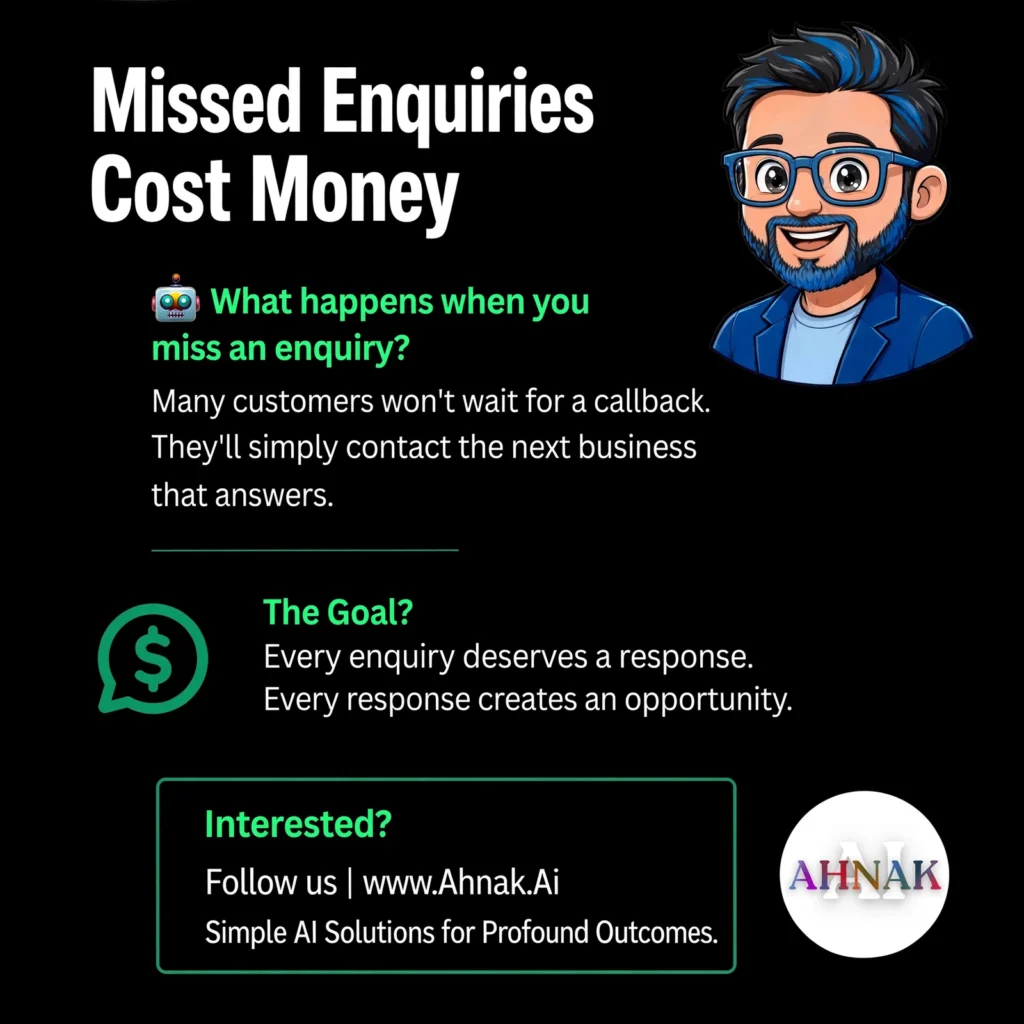
The Hidden Financial Cost of Missed Enquiries
The cost of lost business enquiries is often difficult to see because it does not appear on an invoice or bank statement.
Consider a service business receiving ten enquiries each week.
If even two enquiries are missed or forgotten, and one of those could have become a paying customer, the business may lose meaningful revenue every week.
The impact becomes larger when the customer could have:
- Purchased a high-value service
- Booked repeat work
- Referred friends or colleagues
- Left a positive review
- Continued as a long-term customer
The value of an enquiry is therefore not limited to the first transaction.
A missed opportunity may also mean losing the future relationship connected to it.
Missed Enquiries Can Affect Customer Trust
Customers often form an opinion about a business before the work begins.
If their enquiry receives no acknowledgement, they may assume the business is too busy, unreliable or difficult to reach.
That perception may be unfair, but it can still influence their decision.
A simple acknowledgement can create a very different experience:
Thanks for contacting us. We have received your enquiry and will be in touch shortly.
The full answer may come later, but the customer now knows that the business has received the message and intends to respond.
This is closely connected to the response principles explained in our earlier article, Why Fast Customer Response Matters for Small Business.
Where Are Enquiries Most Commonly Lost?
Missed enquiries usually occur because communication is spread across several channels.
A business may receive customer contact through:
- Phone
- Voicemail
- SMS
- Website forms
- Web chat
- Facebook Messenger
- Instagram messages
- Google Business Profile
When each channel is checked separately, it becomes easier for something to be overlooked.
The problem is often not a lack of customer interest. It is the absence of one clear process for managing all incoming conversations.
How to Find Gaps in Your Enquiry Process
A business can begin by reviewing what currently happens after a customer makes contact.
Ask:
- Who is responsible for checking each channel?
- How quickly is each enquiry acknowledged?
- Where are customer details recorded?
- How does the team know whether follow-up has occurred?
- What happens when a phone call is missed?
- Can someone see the full conversation history?
- How are unanswered enquiries identified?
This review often reveals that enquiries depend heavily on memory, manual notes or individual inboxes.
A stronger process gives each enquiry a clear status and next step.
A Practical Solution: Missed Call SMS Recovery
One useful starting point is missed call recovery.
When a customer calls and nobody is available to answer, the system can automatically send a helpful SMS.
For example:
Sorry we missed your call. Please reply with your name and a brief description of how we can help, and our team will get back to you.
This does not replace a personal callback.
It immediately acknowledges the customer, opens a second communication channel and gives the business an opportunity to collect useful information.
For businesses that regularly work on-site or cannot answer every call, this can help prevent missed calls from becoming lost customers.
You can link this section to your relevant solution or service page:
Internal solution link: Explore Missed Call SMS Recovery
Follow-Up Is Just as Important as Capture
Capturing the enquiry is only the first step.
Some customers may not reply immediately. Others may request information and then become busy themselves.
A clear customer enquiry follow-up process helps the business remain in contact without relying entirely on someone remembering to send another message.
Useful follow-up may include:
- Confirming that requested information was received
- Asking whether the customer still needs assistance
- Reminding them about a quotation or appointment
- Offering a simple next step
- Closing the enquiry respectfully if there is no response
The aim is not to pressure the customer. It is to make sure genuine opportunities are not forgotten.
Can AI Help Manage Missed Enquiries?
Practical AI for small business can help businesses manage the early stages of an enquiry.
AI may assist by:
- Acknowledging incoming messages
- Responding after missed calls
- Asking basic qualifying questions
- Recording customer details
- Answering common questions
- Directing the customer towards booking
- Alerting the team when personal assistance is required
- Keeping conversations together in one customer record
This gives the business more consistency while keeping people involved where judgement, expertise or personal service is needed.
As discussed in Will AI Replace People in Small Business?, the purpose is to support employees—not remove the human relationship.
Every Enquiry Deserves a Clear Next Step
A business cannot control whether every enquiry becomes a customer.
It can control whether every enquiry receives attention.
The most effective enquiry process ensures that each opportunity is:
- Captured
- Acknowledged
- Recorded
- Followed up
- Assigned a clear next step
That next step may be a callback, quotation, appointment, information request or respectful closure.
Without that structure, valuable opportunities can disappear unnoticed.
The Goal Is Not More Leads—It Is Fewer Lost Opportunities
Many businesses focus heavily on generating more leads through advertising, social media or referrals.
That investment is less effective when existing enquiries are being missed.
Before spending more to attract additional customers, it is worth checking whether the business is responding effectively to the interest it already receives.
Reducing missed enquiries can help protect marketing investment, improve the customer experience and create more opportunities from the same level of demand.
Every enquiry deserves a response.
Every response creates an opportunity.