Grow Your Revenue
Without Adding New Staff
OR Utilizing Your Time

AI for Small Business: Is It Only for Big Companies?
AI is no longer limited to large companies. Discover how small businesses can use affordable, practical AI tools to improve customer communication and reduce repetitive work.

AI for Small Business: Is It Only for Big Companies?
Artificial intelligence was once associated mainly with large organisations that had specialist technology teams, significant budgets and access to complex systems.
That is no longer the case.
Today, AI for small business can be practical, accessible and focused on solving everyday operational problems. A small business does not need to build its own artificial intelligence system or employ a team of developers to benefit from AI.
Modern tools can help small and service-based businesses respond to enquiries, manage customer conversations, organise follow-up and reduce repetitive administration.
The important question is not whether a business is large enough to use AI.
The better question is whether AI can solve a genuine problem within the business.
Why Was AI Previously Associated With Large Companies?
Earlier business technology often required substantial investment.
Large companies were more likely to have:
- Dedicated IT departments
- Custom-built software
- Large customer databases
- Complex business processes
- Significant technology budgets
- Specialist employees to manage new systems
This made advanced automation difficult for smaller businesses to access.
Cloud-based software has changed that model. Businesses can now subscribe to technology rather than building and maintaining everything themselves.
As a result, many small business AI tools can be introduced gradually and used without a large internal technology team.
What Does Affordable AI for Small Business Look Like?
Affordable AI for small business does not mean purchasing every available tool or automating every process.
It means selecting a practical solution that addresses a specific and repeated business problem.
For example, a service business may struggle with:
- Missed phone calls
- Slow responses to website enquiries
- Inconsistent customer follow-up
- Manual appointment booking
- Repetitive customer questions
- Messages spread across different channels
- Enquiries being forgotten during busy periods
Each of these problems can affect customer experience and revenue.
A suitable AI solution may help manage one part of that process without requiring the business to make a major technology investment.
Small Businesses May Benefit More From Practical Automation
Large companies often have dedicated receptionists, customer service teams and administrative support.
Small businesses may have one person performing several roles at once.
The owner may be responsible for:
- Delivering the service
- Answering calls
- Preparing quotations
- Managing appointments
- Responding to messages
- Following up customers
- Completing administration
- Marketing the business
When the business becomes busy, customer communication can easily be delayed.
This is where business automation for small business may provide meaningful value. Even a simple automated process can reduce pressure and help the business operate more consistently.
AI Does Not Need to Replace Existing Systems
Introducing AI does not always require replacing the tools a business already uses.
In many cases, AI can work alongside existing communication channels and processes.
For example, customers may continue contacting the business through phone, SMS, email, website forms or social media. An AI-supported system can help acknowledge, organise or respond to those conversations while keeping the business owner informed.
The objective is not to introduce technology for its own sake.
The objective is to make existing customer communication easier to manage.
Practical AI Solutions for Small Businesses
Different businesses will have different priorities, but several practical AI solutions for small businesses can be introduced without attempting a complete transformation.
Missed Call SMS Recovery
A customer who reaches voicemail may immediately contact another provider.
Missed Call SMS Recovery can automatically acknowledge the missed call and invite the customer to reply with basic details.
This helps the business continue the conversation even when nobody was available to answer.
Solution link: Link “Missed Call SMS Recovery”
AI Web Chat
AI Web Chat can help website visitors ask questions, explain what they need and provide contact information outside normal business hours.
It can also help guide the visitor towards an appointment or another appropriate next step.
Solution link: Link “AI Web Chat”
Conversational SMS
Conversational SMS allows customers to continue a two-way discussion rather than receiving only fixed automated messages.
The system can answer routine questions, collect information and involve a person when the conversation requires judgement or expertise.
Solution link: “Conversational SMS”
AI Reception
AI Reception can help manage initial customer contact, answer common questions, collect basic details and direct enquiries appropriately.
This can be useful for service businesses whose employees cannot answer every call while working with customers.
Solution link: “AI Reception”
Automated Follow-Up
An enquiry may receive an initial response but still be lost because nobody follows up.
Automated follow-up can help the business reconnect with customers, confirm their requirements and keep genuine opportunities moving forward.
Solution link: “Automated follow-up”
AI Should Be Introduced According to Business Value
A small business does not need every available AI feature.
The best starting point is usually the process creating the greatest customer or administrative problem.
For example:
- A business missing frequent calls may begin with missed call recovery.
- A business receiving many website visitors may begin with AI Web Chat.
- A business struggling with enquiry management may focus on follow-up and customer records.
- A business spending too much time booking appointments may begin with automated scheduling.
Starting with one clear use case makes it easier to understand the value of the system.
It also allows the business to test the process, make adjustments and expand gradually.
What Should a Small Business Check Before Using AI?
Before introducing AI, the business should consider:
- What specific problem will the system solve?
- How will customers benefit?
- When should a person take over?
- What customer information will be collected?
- How will the business review conversations?
- Does the solution integrate with existing processes?
- Is the expected value greater than the ongoing cost?
AI should simplify the customer journey rather than make it more difficult.
The system should also support clear human oversight.
AI Is Not a Shortcut for Poor Processes
Technology cannot fully solve a process that has not been clearly defined.
For example, automatically collecting customer information will not help if nobody knows who is responsible for reviewing the enquiry.
Before introducing automation, the business should establish:
- Where the enquiry is recorded
- Who owns the next step
- When follow-up should occur
- When human assistance is required
- How the outcome will be tracked
AI can then support that process more reliably.
AI for Service-Based Businesses
AI for service-based businesses is particularly useful because customer enquiries often arrive while the owner or team is busy delivering the service.
An electrician may be working on-site. A plumber may be driving between jobs. A tutor may be teaching. A music teacher may be in a lesson. A builder may be coordinating contractors.
In each case, it may be difficult to stop and respond immediately.
AI can help acknowledge the customer and collect initial information without interrupting the work already underway.
The person can then continue the conversation when available.
Small Businesses Do Not Need to Automate Everything
A sensible AI strategy is gradual.
A business may begin with one problem, measure the results and decide whether another process should be improved.
This avoids unnecessary complexity and helps ensure that every new feature has a clear purpose.
As explained in What Is AI for Small Business?, AI works best when it is treated as a practical assistant rather than a complicated technology project.
The goal is not to become the most automated business.
The goal is to become a more responsive, organised and effective business.
The Real Advantage of AI for Small Business
Small businesses often compete through personal service, specialist expertise and strong customer relationships.
AI should strengthen those advantages rather than replace them.
Used properly, AI can help a business:
- Respond faster
- Miss fewer opportunities
- Follow up more consistently
- Reduce repetitive administration
- Keep customer communication organised
- Give employees more time for valuable work
- Support growth without immediately adding more workload
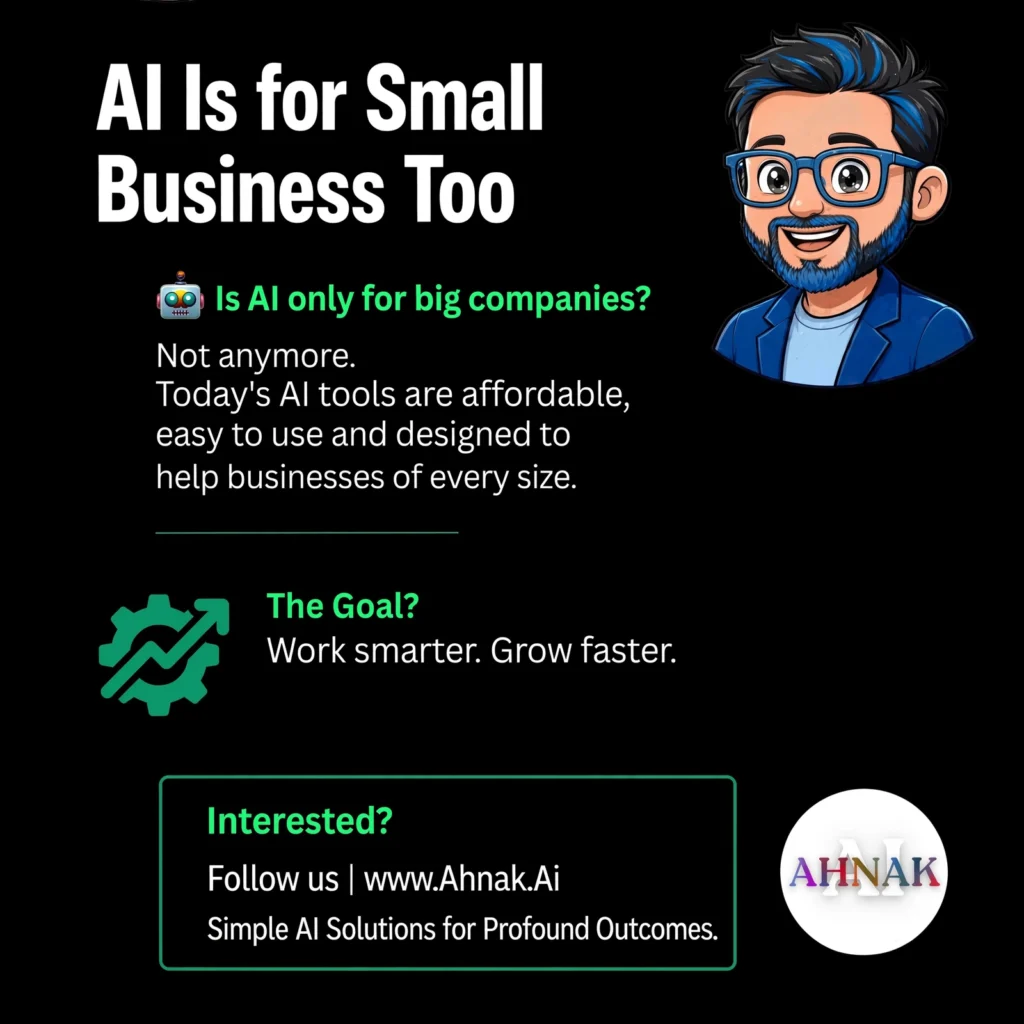
AI is no longer only for large companies.
It is becoming a practical option for small businesses that want to work smarter, serve customers more consistently and grow sustainably.